























ANATOMIA ANIMÆ HVMANÆ
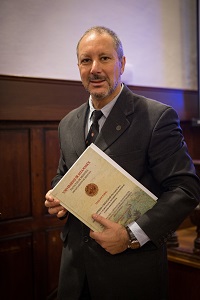
Prof. Dr. Carlos Gabriel CHADA CASTRO
ANATOMIA ANIMÆ HVMANÆ
Prof. Dr. Carlos Gabriel
CHADA CASTRO
Carlos Gabriel Chada-Castro
ψυχῆς ἰατρεῖον / Remedios del alma / Remèdes de l’âme / Medicines for the soul / medicine dell’anima / Medikamente Geist / remédios da alma


Remedies for the soul
An inner library
It is said that above the entrance to the sacred library of Ramses II —the long-reigning pharaoh whose sovereignty seemed to endure with the same mineral obstinacy as the temples he erected— there once appeared the Greek inscription ψυχῆς ἰατρεῖον: “remedies for the soul.” Perhaps no phrase has ever defined more precisely what books have represented for certain civilizations and, secretly, for myself as well: not mere repositories of words, but instruments of inner transfiguration, discreet forms of spiritual medicine, and laboratories of multiple temporalities.
Books have always awakened in me an almost Orphic fascination. Every library is, at bottom, a dialogue with heterogeneous regions of time: linear and circular, simultaneous and divergent, historical and mythical. To open a book is to enter a domain where the dead continue speaking and where ideas survive their authors with a persistence no biology could entirely explain. Perhaps this is why Jorge Luis Borges imagined paradise under the form of a library, while Umberto Eco regarded it not merely as an archive of knowledge, but as a machine against oblivion.
The biographical narratives that shape each individual existence are irreducibly singular, for every human being emerges from a unique convergence of nature, culture, and history. There is here a possible analogy with games of chance: the cards are dealt arbitrarily, yet what ultimately matters is not the hand one receives, but the manner in which one chooses to play it. The margin of freedom begins precisely where mere facticity ends. Suspended between chance and necessity —or more exactly, poised above both— human beings advance along what might be called the precipice of freedom.
Maurice Merleau-Ponty spoke of a “situated freedom”: never absolute, never disembodied, always conditioned by a body, a history, an epoch, and a set of circumstances. Yet even within such limits, freedom remains the very core of the human condition. Deprived of it, man would be reduced to a biologically sophisticated automatism: a creature endowed with a remarkable nervous system yet incapable of transcending mere mechanical reaction. Perhaps a considerable portion of postmodernity consists precisely in this gradual renunciation of inner freedom in exchange for substitutes of comfort, distraction, and anaesthesia.
Rather than a conventional introduction, I would prefer this page to be understood as a discreet space for the aggregation of words, intuitions, and questions. In other cultural traditions I might have resorted not to words, but to ideograms; or perhaps, yielding to a certain minimalist temptation, to only a few phonemes. For every language conceals an implicit metaphysics, and every symbolic system shapes the experience of reality in a different way.
I studied medicine, psychiatry, philosophy, anthropology, and other disciplines pertaining to the human endeavour. I passed through centuries-old universities in an attempt to deepen my inquiry into that strange living being whom Socrates, in the “Cratylus” of Plato, describes to Hermogenes as the creature who not only sees, but contemplates what he has seen; who not only perceives, but examines his own perception. Man would thus be the being capable of turning reflexively upon his own experience and interrogating it. Even today, this remains one of the most unsettling anthropological definitions ever formulated.
At this point I feel tempted to place a full stop. Yet full stops belong more to syntax than to existence. Life rarely concludes with the orderly closure of paragraphs. The Lebenswelt —the “life-world” described by Edmund Husserl— resembles less a systematic treatise than a manuscript filled with erasures, interpolations, and unfinished pages.
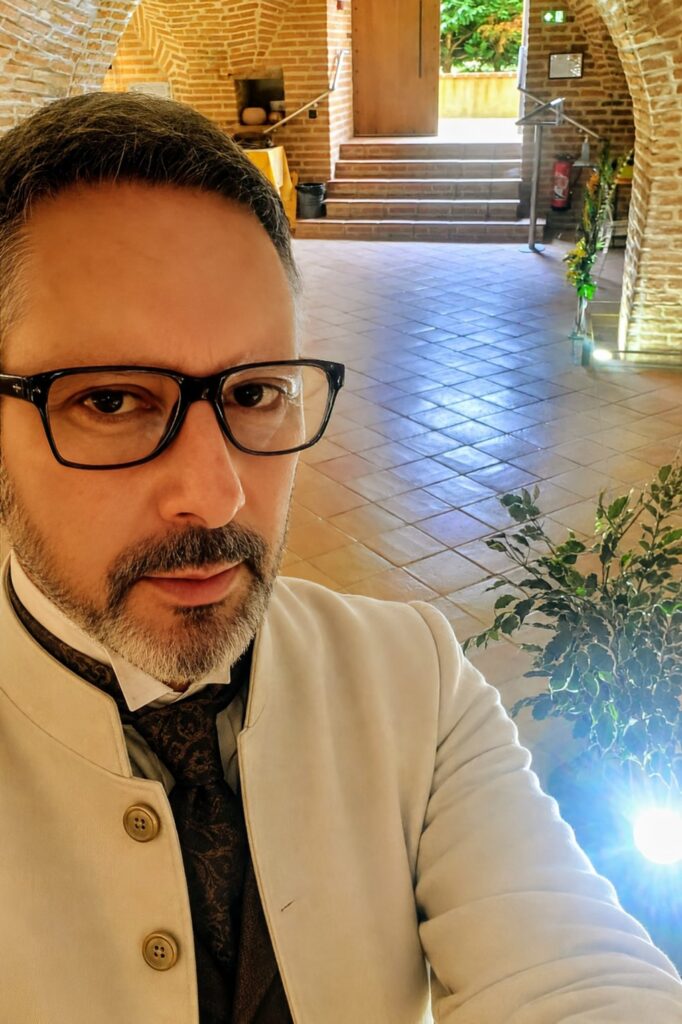
This page therefore serves a double purpose. On the one hand, it seeks to offer a necessarily fragmentary portrait of the person who writes it; on the other, it attempts —within the limits of my abilities— to respond to questions arising in the field to which I have devoted most of my intellectual life: psychopathology and psychiatry.
In this regard, the celebrated definition proposed by Henri Ey remains profoundly revealing when he stated that psychiatry is “the study of the pathology of freedom.” Few formulations have condensed with such precision the anthropological drama underlying mental illness. For at the heart of many psychic disorders there always appears a disturbance in the relationship between freedom, desire, will, and reality.
I would finally like to add a few words concerning the symbolic resonance of the name of this page: Eudemoniapsyche. The term εὐδαιμονία (eudaimonia), central to the “Nicomachean Ethics” of Aristotle, is often inadequately translated as “happiness.” In truth, it refers to something far deeper: a fullness of being, an inner harmonization of reason, character, and virtue. For Aristotle, the supreme good does not consist in wealth, honours, fame, or even pleasure considered in isolation, but in the virtuous realization of one’s existence in accordance with right reason.
Late modernity, however, seems to have replaced this ancient ethical aspiration with a hypertrophy of desire and recognition. Contemporary man has become trapped within a permanent economy of comparison, visibility, and external validation. Hence so many contemporary forms of psychic suffering may be interpreted as distortions of affectivity, will, or thought itself: depression, bipolar disorders, psychoses, narcissistic pathologies, compulsions, states of anxiety and anguish, impulsive behaviours, or personality disorders. The Diagnostic and Statistical Manual of Mental Disorders -DSM- merely maps, through its classificatory language, the many variants of this inner fracture.
Ultimately, all these clinical forms converge upon the same reality: different modalities of the pathology of freedom. Anguish itself may be defined as the vertigo experienced before the possibility of a free act. Søren Kierkegaard understood with remarkable lucidity that anguish is not merely a symptom, but also the very condition of freedom itself. Without anguish there could be no authentic choice, because only the being capable of failure is genuinely free.
From this perspective, Eudemoniapsyche may be understood as the state of a soul reconciled with its own virtue: a form of inner equilibrium that has finally grasped that wealth, fame, honours, and pleasure pursued for their own sake are merely simulacra of happiness. Perhaps the neologism “dyseudemonia” might better describe the spiritual atmosphere of our age: a humanity immersed in a permanent existential disquiet, incapable of accepting its own limits and obsessed with the impossible divinization of itself. Our contemporary tragedy may ultimately consist in wishing to become gods before having accepted our mortal condition. Yet such pretension is not greatness. It is merely ὕβρις — hybris.
Professional activity
Consultant in GENERAL ADULT PSYCHIATRY
Docente regular invitado
VISITING LECTURER
Professor visitante
Gastprofessor
Psiquiatra y docente adjunto en cátedra de clínica psiquiátrica
VISITING LECTURER
Psychiatre des hôpitaux en FRANCE
university degrees
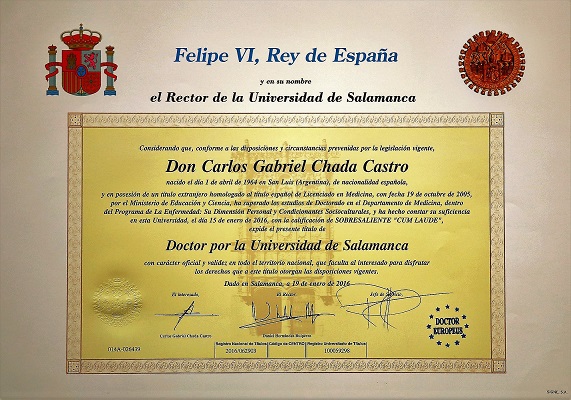
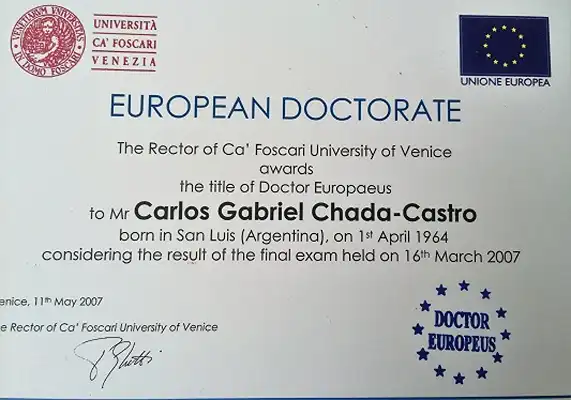
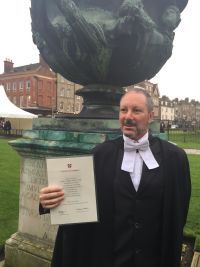
“DOCTOR EUROPÆUS EN MEDICINA Y PSIQUIATRIA”
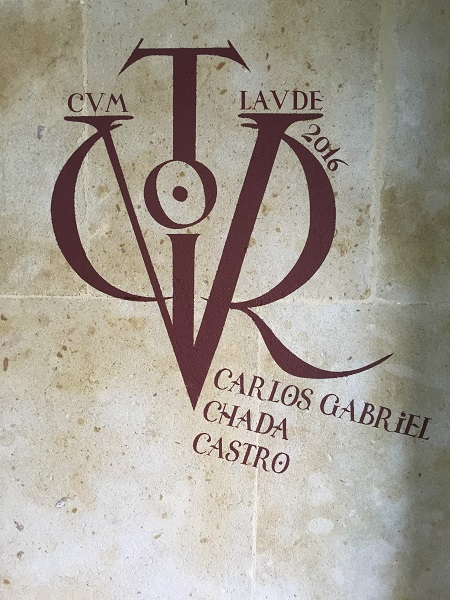
“VÍTOR DE DOCTOR EN MEDICINA Y PSIQUIATRÍA CVM LAVDE”
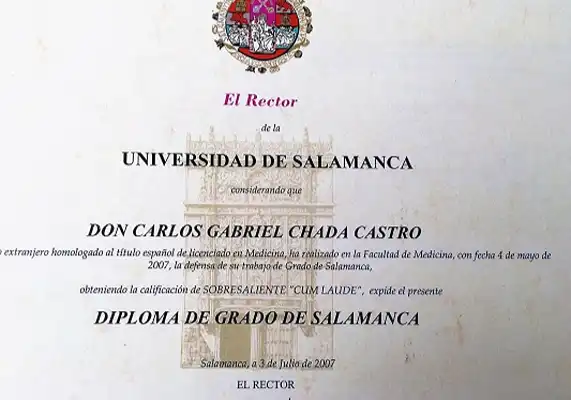
“GRADO DE SALAMANCA”
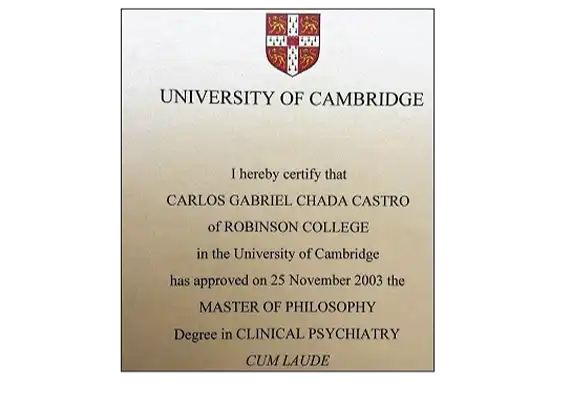
“MASTER OF PHILOSOPHY – Medical Sciences and Psychiatry”
“DOCTOR EN FILOSOFÍA”
Calificación sobresaliente CVM LAVDE
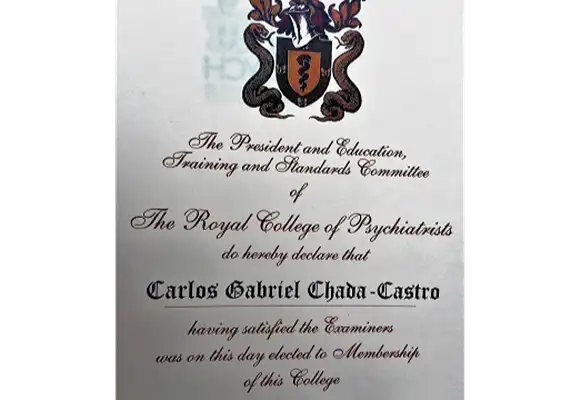
Full Member of the ROYAL COLLEGE OF PSYCHIATRISTS
UNITED KINGDOM
“Specialist in GENERAL ADULT PSYCHIATRY”
STA: The Specialist Training Authority of THE MEDICAL ROYAL COLLEGES – UNITED KINGDOM
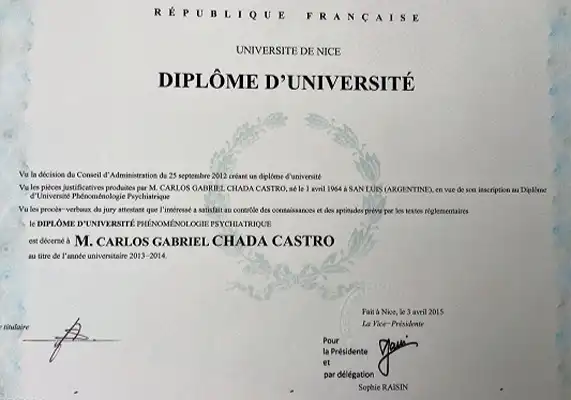
« DIPLÔME D’UNIVERSITÉ en PHÉNOMÉNOLOGIE PSYCHIATRIQUE »
UNIVERSITÉ DE NICE – FRANCE
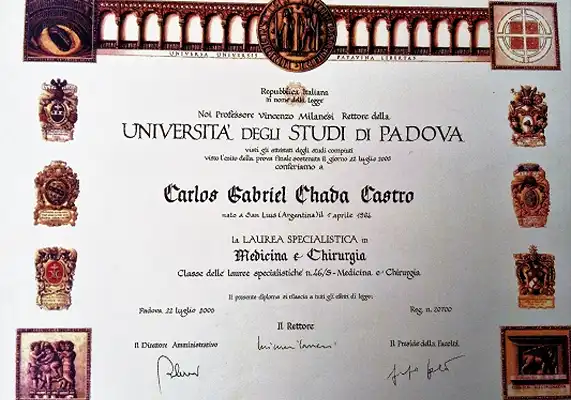
“Laura specialistica in MEDICINA e CHIRURGIA”
UNIVERSITÀ DEGLI STUDI DI PADOVA – ITALIA
“Título de ESPECIALISTA UNIVERSITATIO en PSIQUIATRÍA”
UNIVERSIDAD NACIONAL DE CÓRDOBA – ARGENTINA
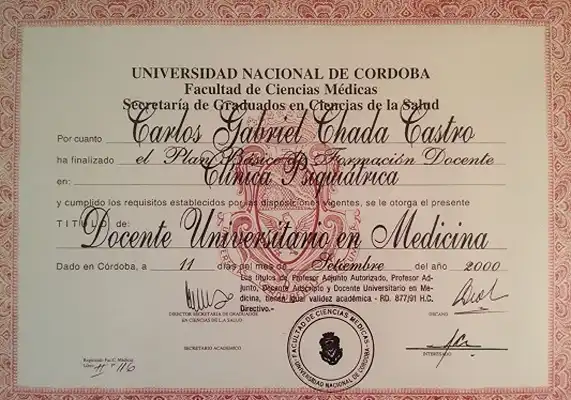
“Título de DOCENTE UNIVERSITARIO EN MEDICINA, Área PSIQUIATRÍA”
UNIVERSIDAD NACIONAL DE CÓRDOBA – ARGENTINA
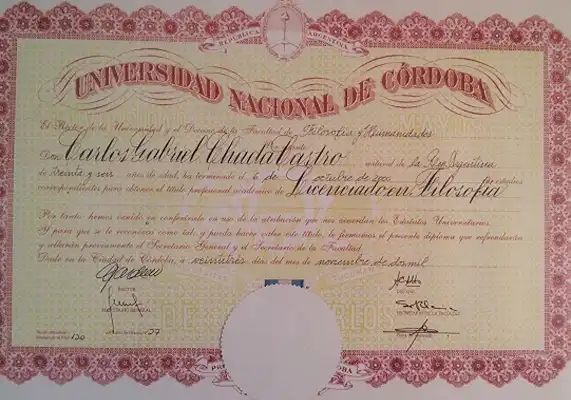
“Título de LICENCIADO EN FILOSOFÍA”
UNIVERSIDAD NACIONAL DE CÓRDOBA – ARGENTINA
“Diploma de postgrado en PSICOTERAPIA EXISTENCIAL”
UNIVERSIDAD NACIONAL DE CÓRDOBA – ARGENTINA
“Diploma de postgrado en PSIQUIATRÍA BIOLÓGICA”
UNIVERSIDAD NACIONAL DE CÓRDOBA – ARGENTINA
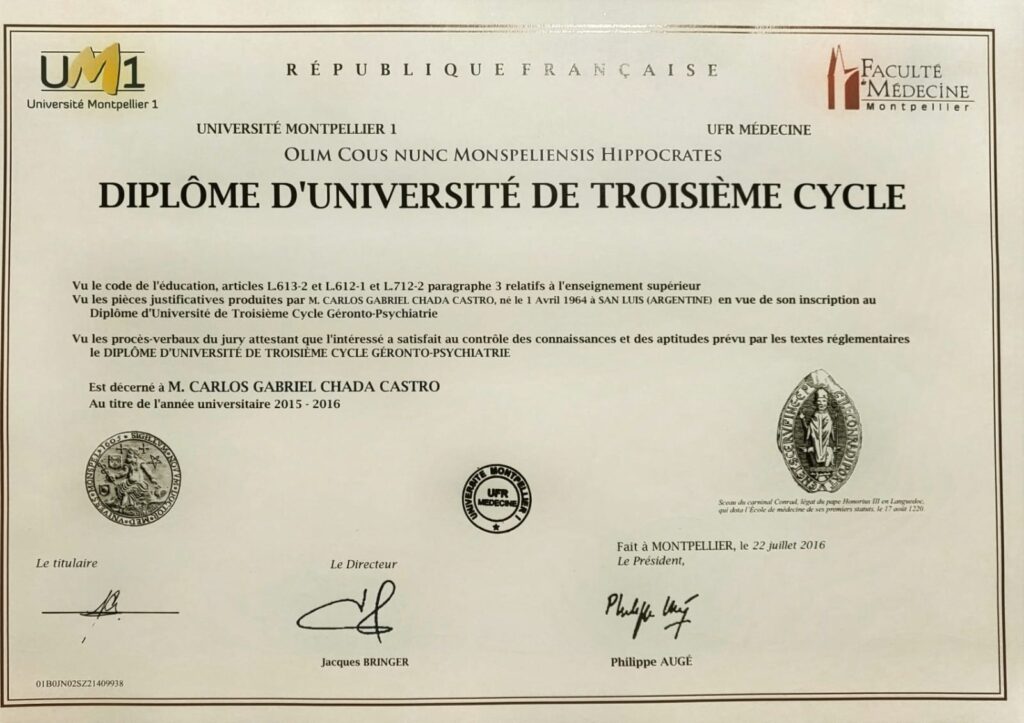
« DIPLÔME D’UNIVERSITÉ en GÉRONTO-PSYCHIATRIE »
UNIVERSITÉ DE MONTPELLIER – UFR MÉDECINE – FRANCE
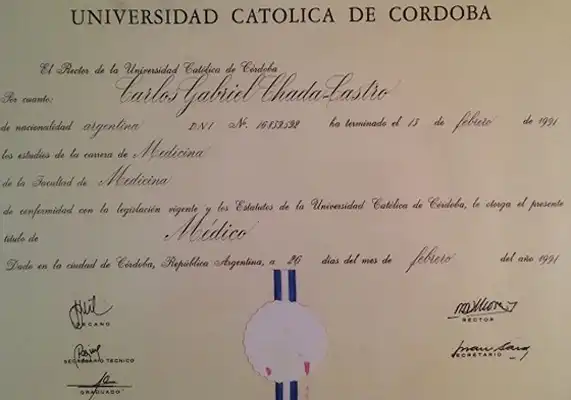
“Título de MÉDICO”
UNIVERSIDAD CATÓLICA DE CÓRDOBA – ARGENTINA
“DOCTOR EUROPÆUS EN MEDICINA Y PSIQUIATRIA”
“VÍTOR DE DOCTOR EN MEDICINA Y PSIQUIATRÍA CVM LAVDE”
“GRADO DE SALAMANCA”
“MASTER OF PHILOSOPHY – Medical Sciences and Psychiatry”
“DOCTOR EN FILOSOFÍA”
Calificación sobresaliente CVM LAVDE
Full Member of the ROYAL COLLEGE OF PSYCHIATRISTS
UNITED KINGDOM
“Specialist in GENERAL ADULT PSYCHIATRY”
STA: The Specialist Training Authority of THE MEDICAL ROYAL COLLEGES – UNITED KINGDOM
« DIPLÔME D’UNIVERSITÉ en PHÉNOMÉNOLOGIE PSYCHIATRIQUE »
UNIVERSITÉ DE NICE – FRANCE
“Laura specialistica in MEDICINA e CHIRURGIA”
UNIVERSITÀ DEGLI STUDI DI PADOVA – ITALIA
“Título de ESPECIALISTA UNIVERSITATIO en PSIQUIATRÍA”
UNIVERSIDAD NACIONAL DE CÓRDOBA – ARGENTINA
“Título de DOCENTE UNIVERSITARIO EN MEDICINA, Área PSIQUIATRÍA”
UNIVERSIDAD NACIONAL DE CÓRDOBA – ARGENTINA
“Título de LICENCIADO EN FILOSOFÍA”
UNIVERSIDAD NACIONAL DE CÓRDOBA – ARGENTINA
“Diploma de postgrado en PSICOTERAPIA EXISTENCIAL”
UNIVERSIDAD NACIONAL DE CÓRDOBA – ARGENTINA
“Diploma de postgrado en PSIQUIATRÍA BIOLÓGICA”
UNIVERSIDAD NACIONAL DE CÓRDOBA – ARGENTINA
« DIPLÔME D’UNIVERSITÉ en GÉRONTO-PSYCHIATRIE »
UNIVERSITÉ DE MONTPELLIER – UFR MÉDECINE – FRANCE
“Título de MÉDICO”
UNIVERSIDAD CATÓLICA DE CÓRDOBA – ARGENTINA
Books, publications, and presentations.
Schizphrenia and sexuality
A review and report of 80 cases (British Journal of Psychiatry)
Sexuality and psychoses
A phenomenological approach (Comprehensive Psychiatry)
Schizphrenia and sexuality
Con un saggio clinico di Chada-Castro, Carlos Gabriel, 5 edizione ampliata, Milano,1999 (355pp)
La psichiatria e la fenomenologia al tempo di Jaspers
« RITORNO ad ATENE » Studi in onore di Umberto Galimberti, A cura di Gianluigi Pasquale. Carocci editore, Roma, 2012
Fenomenologia e Psichiatria
Una revisione critica sulle fonti filosofiche della Psicopatologia Generale di Karl Jaspers (Dottorato europeo di ricerca, 347 pp., Ediz. Della Università degli Studi di Venezia, Ca’Foscari, Venezia, marzo 2007)
Borderline Personality Disorder
A conceptual history (MPhil under the supervision of Prof. G.E.Berrios, University of Cambridge, October 2003)
Schizphrenia and sexuality
Panelist on a TVE program, March 2013, MADRID, on 'The disease of our time
Consectetur tellus nec
(Cahiers de l’Université de Nice, 2014)
contact
Para consultas profesionales, académicas o relacionadas con publicaciones, ponencias y colaboraciones, puede utilizar este formulario. Este espacio está orientado a establecer una comunicación directa y cuidada en torno a la psiquiatría, la psicopatología, la filosofía y otros ámbitos vinculados al pensamiento y la vida interior.